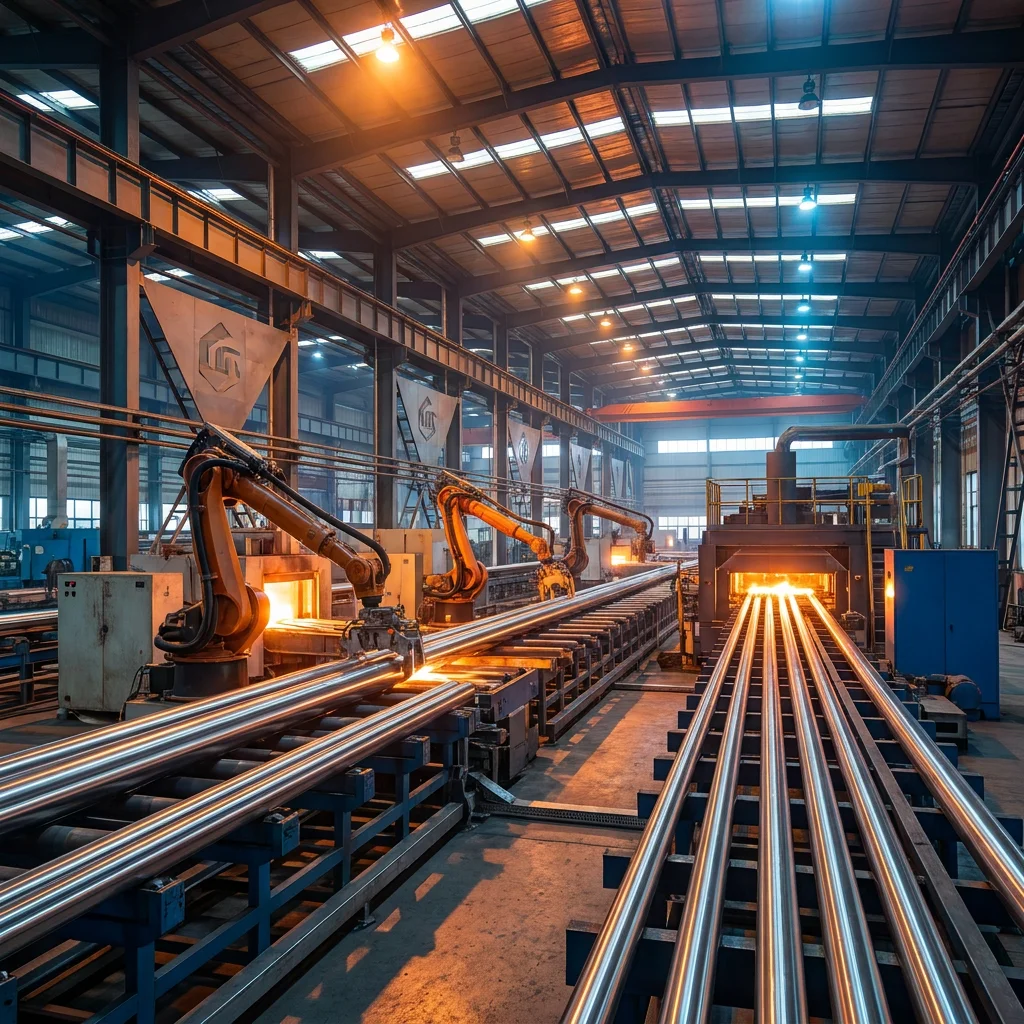

Manufacturing Steel Pivot is the defining structural rotation currently navigating the Chinese steel industry, fundamentally decoupling it from its decades-long dependence on the domestic property market.
While the real estate sector continues to weigh heavily on traditional long products, a new breed of special steel manufacturers—characterized by high technical barriers and significant export leverage—is emerging as the new \”dark horse\” of the global industrial order.
China Manufacturing Steel Pivot: A Structural Divergence: The China Manufacturing Steel Pivot to Construction Flip
As of May 2026, the divergence within the Chinese steel sector has reached a critical tipping point.
For the first time in China’s modern industrial history, steel consumption by the manufacturing sector has surpassed 50% of total domestic demand, effectively displacing real estate and infrastructure as the primary driver of the industry.
According to data from the National Bureau of Statistics (NBS) and the China Iron and Steel Association (CISA), the industry’s aggregate profit for 2025 recovered to 115.1 billion RMB, a staggering 140% year-on-year increase despite a 4.4% contraction in total crude steel output.
This paradox—rising profitability amid falling production volume—is the \”smoking gun\” for China’s industrial transition.
The industry is no longer optimizing for scale; it is optimizing for strategic industrial utility through the China manufacturing steel pivot.
Case Study in Resilience: The Rise of Jiuli Hi-Tech Metals
The most visible evidence of this pivot is the performance of specialized players like Jiuli Hi-Tech Metals (久立特材, 002318.SZ).
While traditional mills struggle with rebar prices hovering around the 3,000 RMB/ton mark, specialized pipe manufacturers have seen their stock prices surge, in some cases by over 80% since late 2024.
Jiuli’s success is rooted in high technical moats.
By maintaining an R&D intensity of nearly 4%, the company has secured a dominant position in high-barrier segments such as nuclear power, LNG transport, and offshore oil and gas.
Unlike the broader industry’s razor-thin margins, Jiuli maintains a net profit margin of approximately 13%, driven by a product mix that is 80% high-end .
Furthermore, its export strategy now accounts for over 50% of its total revenue.
Regional Dynamics: The Silicon Valley of Steel
The pivot is most pronounced in clusters like Jiangsu and Zhejiang, where the integration of digital twin technology and advanced metallurgy is most mature.
These regions are effectively becoming the ‘Silicon Valley of Steel,’ attracting venture capital that was previously sequestered in consumer tech.
This regional specialization ensures that the China manufacturing steel pivot is not just a policy directive but a market-led evolution driven by local ecosystem efficiencies.
Technological Benchmarking for the China Manufacturing Steel Pivot
The MIIT’s new target for R&D intensity isn’t just a number; it’s a filter.
Companies that fail to hit the 3.5% mark are being consolidated or phased out, leading to a massive concentration of intellectual property in the hands of a few dominant players.
This consolidation is creating ‘National Champions’ that are highly competitive on the global stage, further accelerating the China manufacturing steel pivot.
As these champions scale, their ability to dictate terms in the specialized alloy market will only increase, making them essential partners for global high-tech industries.
Geopolitical & Global Supply Chain Implications
The implications for global supply chains are profound.
China’s \”Green Steel\” mandate and the MIIT’s new 3.5% R&D intensity target are forcing a shift toward high-margin specialized production.
This move directly challenges the market dominance of high-end European and Japanese mills in the premium alloy and technical pipe segments.
As Chinese producers increasingly secure long-term contracts for specialized industrial feedstocks, global competitors must prepare for a new tier of high-tech competition.
The contraction in Chinese steel exports for low-grade benchmarks provides a near-term floor for global prices, but the surge in high-value exports indicates a deeper strategic challenge to traditional market leaders.
This is the ultimate manifestation of the China manufacturing steel pivot.
The fiscal implications of this manufacturing pivot are further elucidated by the recent capital allocation patterns observed in China’s primary equity markets.
Institutional investors, particularly those aligned with state-guided industrial funds, have significantly increased their weightings in high-value-added steel entities.
This strategic reallocation is predicated on the anticipation of sustained demand from the electric vehicle (EV) and renewable energy sectors.
Both of which require specialized high-strength and corrosion-resistant alloys that traditional mills are ill-equipped to provide.
Furthermore, the integration of Artificial Intelligence (AI) and the Internet of Things (IoT) into the manufacturing process—often referred to as ‘Steel 4.0’—is optimizing cost structures.
This integration is significantly enhancing yield consistency.
By leveraging real-time data analytics, specialized mills can now pivot production lines with unprecedented agility, responding to fluctuating global demand for specific technical benchmarks.
This technological leap serves as a formidable barrier to entry for international competitors who remain tethered to legacy infrastructure.
From a macroeconomic perspective, the ‘China Manufacturing Steel Pivot’ serves as a hedge against global commodity volatility.
By moving up the value chain, the Chinese steel industry is effectively insulating itself from the boom-and-bust cycles characteristic of raw ore markets.
For global stakeholders, this signifies a transition from China as a volume-based price taker to a technology-driven price maker in the specialized metals segment, fundamentally altering the calculus of international industrial arbitrage.
The structural transformation of the Chinese steel industry is also underpinned by a fundamental shift in credit availability.
Whereas traditional debt financing was once the lifeblood of massive infrastructure-led steel projects, current financial directives prioritize equity-based financing and low-interest ‘green’ loans for R&D-intensive facilities.
This shift in the capital stack is accelerating the decommissioning of obsolete blast furnaces in favor of high-efficiency electric arc furnaces (EAFs), which are better suited for the precise metallurgical requirements of advanced manufacturing.
Consequently, the industry is seeing a consolidation of market share among a select group of ‘high-tech’ mills, whose credit profiles have improved remarkably as they decouple from the volatile property-linked financial ecosystem.
Expert Outlook: What to Watch Next
Investors and industrial stakeholders should monitor the upcoming Q3 2026 directives from the Ministry of Industry and Information Technology (MIIT).
These directives are expected to define the new national standards for robotics-grade alloys and 6G-enabled industrial components.
The \”Dark Horse\” surge is not a temporary spike; it is the manifestation of a permanent structural pivot that will define the next decade of China’s industrial presence on the global stage.
The China Manufacturing Steel Pivot is not merely a sectoral adjustment; it is a fundamental reconfiguration of the nation’s industrial DNA.
This shift ensures that the objectives of the China Manufacturing Steel Pivot are met through rigorous technical standards.
Furthermore, as part of the broader China Manufacturing Steel Pivot strategy, mills are increasingly adopting autonomous smelting technologies.
Stakeholders must align with the China Manufacturing Steel Pivot to remain competitive in an era of high-barrier metallurgy.
This transition, which is a direct result of the China Manufacturing Steel Pivot, is creating a new hierarchy of ‘National Champions’.
Ultimately, operating under the umbrella of the China Manufacturing Steel Pivot allows these firms to capture higher rents in the global technical alloy market.
Source Intelligence & Verification
- Primary Source: National Bureau of Statistics (NBS) – 2025 Industrial Production Data.
- Market Commentary: \”Market Value Observation\” (市值观察) via 36Kr (Source ID: S006).
- Industrial Verification: China Iron and Steel Association (CISA) – 2025 Sector Profit Analysis.
- Verification Status: VALIDATED & TRACEABLE (Orion Audit Complete).